
FAQS
Frequently Asked Questions

We understand you may have questions about restorative pigmentation and our services.
Below are answers to the most common questions we receive from our clients and referral partners.
Frequently Asked Questions
-
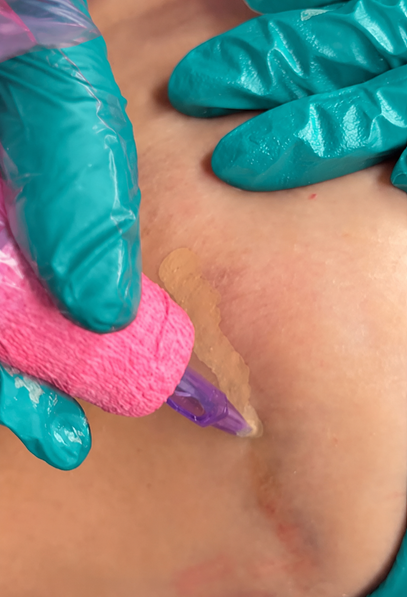
Restorative pigmentation is a specialized form of cosmetic pigmentation used to help reduce visible color differences in areas such as mature scars, stretch marks, and certain areas of pigment loss.
Rather than removing a scar or changing the underlying skin, carefully selected pigment is introduced with the goal of helping an appropriate treatment area blend more naturally with the surrounding skin.
Every person's skin, healing response, and starting point is different, so results vary and an exact color match or specific outcome cannot be guaranteed.
-
Depending on individual eligibility and the condition of the skin, services may include:
Scar camouflage and re-pigmentation
Stretch mark re-pigmentation
Areola restoration
Custom temporary areola restoration
Acne scar, burn scar and other appropriate areas of hypo-pigmentation
Not every skin difference is appropriate for pigmentation. New, changing, unexplained, irritated, or medically concerning skin changes should be evaluated by an appropriate healthcare professional before cosmetic treatment is considered.
-
You don't need to figure that out alone.
A complimentary introductory call is available for general questions and to help determine which service or consultation may be appropriate.
If individualized assessment is needed, a comprehensive virtual or in-person consultation allows us to evaluate your concerns, goals, treatment area, and other relevant factors before recommending a treatment plan.
-
Yes, a consultation gives us the opportunity to evaluate the treatment area, discuss your goals and expectations, review relevant history and potential contraindications, and determine whether your skin appears appropriate for the requested service.
It also gives you the opportunity to ask questions and decide whether treatment feels right for you before making a larger commitment.
-
Yes. Virtual consultations are available for services that can be appropriately evaluated remotely.
Depending on the service, you may be asked to provide photographs, measurements, or additional information to assist with preliminary planning.
Some circumstances may still require an in-person assessment before treatment can be performed.
-
No. Restorative pigmentation does not remove scars or stretch marks.
The goal is to reduce visible color contrast so an appropriate treatment area blends more naturally with the surrounding skin.
Texture, depth, width, and other structural characteristics of the skin may remain visible even when color contrast is improved.
We believe in setting realistic expectations rather than promising that a scar or stretch mark will disappear.
-
The treatment area must be fully healed and sufficiently mature before restorative pigmentation is considered.
Scar maturation varies considerably between individuals and types of injury or surgery. Color, texture, tenderness, vascularity, stability, and other characteristics may be considered when determining readiness.
If a scar is still actively changing, raised, irritated, painful, inflamed, unusually red, or otherwise concerning, treatment may need to be postponed and medical evaluation may be recommended.
-
Some mature, stable surgical and injury-related scars may be candidates for restorative pigmentation.
Eligibility depends on factors including the scar's maturity, color, texture, location, surrounding skin, healing history, and individual risk factors.
A consultation is necessary to determine whether a particular scar appears appropriate for treatment.
-
Some mature stretch marks that are lighter than the surrounding skin may be candidates for re-pigmentation.
Treatment is intended to reduce color contrast rather than eliminate the stretch mark itself.
Because stretch marks involve structural changes within the skin, texture may remain visible even after successful color blending.
-
The primary purpose of our re-pigmentation services is color restoration and visual blending.
Some individuals may notice changes in the appearance or feel of treated skin during the healing process, but texture improvement is not guaranteed and should not be the primary expectation of pigmentation treatment.
-
There is no universal number of sessions.
Restorative pigmentation is generally a gradual process, and multiple sessions may be necessary to build and refine color safely.
The number of sessions can depend on the treatment area, skin characteristics, existing color difference, healing response, pigment retention, treatment goals, and other individual factors.
Your recommended treatment plan will be discussed during your consultation and reassessed as your skin heals.
-
Skin needs time to heal and for implanted pigment to settle before the true result of a session can be evaluated.
Treating an area again before it has adequately healed can interfere with accurate color assessment and may increase unnecessary trauma to the skin.
Restorative work requires patience. We prioritize the long-term integrity of your skin over rushing the process.
-
Our goal is to create the most natural-looking integration reasonably achievable, but an exact match cannot be guaranteed.
Natural skin is complex. Its appearance changes with lighting, circulation, temperature, sun exposure, tanning, aging, and other factors, while implanted pigment behaves differently from naturally occurring melanin.
Color selection and adjustment are therefore individualized and may require more than one session.
-
Pigment longevity varies.
Implanted pigment can gradually change or fade over time due to individual skin characteristics, immune response, sun exposure, lifestyle, treatment location, pigment characteristics, and other factors.
Future maintenance or color refreshing may be desired.
-
Pigment implanted into the skin does not tan in the same way your natural melanin does.
If surrounding skin becomes significantly darker from sun exposure or tanning, the treated area may temporarily appear more noticeable.
Consistent sun protection can help minimize changes in contrast and protect both your skin and the appearance of your pigmentation.
-
Restorative pigmentation involves intentionally introducing pigment into the skin and therefore carries risks similar to other forms of body art, including infection, allergic or inflammatory reactions, pigment changes, scarring, and unsatisfactory cosmetic results.
We use infection-control practices, single-use sterile supplies where applicable, careful screening, informed consent, and detailed aftercare instructions to reduce avoidable risks.
No procedure that breaks the skin can be described as completely risk-free.
-
Certain skin conditions, medications, medical circumstances, healing problems, active infections, recent procedures, or other risk factors may make treatment inappropriate or require postponement or medical clearance.
Please provide complete and accurate information during your consultation and health screening.
Our priority is not to perform every requested treatment. It is to proceed only when treatment appears reasonably appropriate and within our training, scope, and safety standards.
-
Please disclose relevant medical conditions, medications, supplements, allergies, previous reactions, healing difficulties, and other requested information during your consultation.
Having a medical condition does not automatically mean you cannot receive a service. However, some circumstances may affect healing or treatment eligibility.
When a concern falls outside our scope, we may postpone treatment or recommend that you speak with an appropriate licensed healthcare professional before proceeding.
-
If an area is new, changing, unexplained, symptomatic, suspicious, or has not been appropriately diagnosed, medical evaluation should come first.
Restorative pigmentation is cosmetic and does not diagnose or treat skin disease.
We will not intentionally camouflage a concerning skin change simply to make it less visible.
-
Results in skin affected by vitiligo can be unpredictable and should not be considered a permanent cure.
Restorative pigmentation introduces cosmetic pigment; it does not restore normal melanin production or treat the underlying condition. Vitiligo can change or progress, and implanted color can fade or become mismatched if the surrounding skin changes.
Results and longevity vary considerably from person to person and cannot be guaranteed.
A consultation and appropriate medical evaluation may be recommended before treatment.
-
No.
Loss of skin pigmentation can have many causes, and cosmetic pigmentation should not be used as a substitute for diagnosis.
New, changing, unexplained, or medically concerning areas should first be evaluated by an appropriate healthcare professional.
Once the cause and stability of an area are appropriately understood, we can discuss whether restorative pigmentation may be an option.
-
Areola restoration may be considered by individuals who have experienced changes or loss of the nipple-areola appearance following mastectomy, breast reconstruction, other breast surgery, injury, or other appropriate circumstances.
Eligibility depends on healing, skin condition, surgical history as relevant to safe treatment, individual risk factors, and treatment goals.
A consultation is required before permanent restorative pigmentation.
-
The breast and treatment area must be fully healed before restorative pigmentation is considered.
Healing timelines vary based on the procedure performed, complications, additional treatment, reconstruction method, and individual recovery.
Your surgeon or other treating healthcare professional may need to confirm that the area is adequately healed before pigmentation.
There is no benefit to rushing restorative work on tissue that is not ready.
-
A custom temporary areola is a non-permanent option designed to recreate the visual appearance of an areola without implanting pigment into the skin.
Depending on the service selected, customization may incorporate measurements, color assessment, photography, digital imaging, design preferences, and individualized color matching.
It can provide an option for people who are not ready for permanent pigmentation, are waiting for treatment, cannot undergo another invasive procedure, or simply prefer a temporary solution.
-
No.
Temporary areola products are applied to the surface of the skin and do not require tattooing or pigment implantation.
Application, wear, removal, skin sensitivity, and other instructions are provided with the product.
-
When appropriate, a remaining natural areola may be used as a visual reference for the custom design.
Photography, measurements, color information, and digital design techniques can be used to create a corresponding design.
Because photography, displays, printers, lighting, skin characteristics, and temporary-transfer materials all affect perceived color, an exact reproduction cannot be guaranteed.
-
You can still explore custom temporary areola restoration.
Design options can be developed using your skin tone, anatomy, measurements, aesthetic preferences, and available reference designs.
The goal is to create an option that feels appropriate and personal to you rather than assuming there is one "correct" areola appearance.
-
Comfort varies from person to person and depends on the treatment area, scar characteristics, individual sensitivity, previous procedures, and other factors.
Some people experience relatively little discomfort, while others are more sensitive.
We will discuss what you may reasonably expect for your particular service before treatment.
-
The treated area may initially appear darker, brighter, warmer, or more noticeable than the final healed result.
Temporary redness, tenderness, swelling, dryness, flaking, or other normal healing changes may occur depending on the procedure and individual response.
Pigment appearance can change substantially during healing, so the immediate post-treatment color should not be considered the final result.
You will receive service-specific aftercare instructions explaining how to care for the area and when to contact us or seek medical attention.
-
You will receive instructions explaining expected healing and signs that require additional attention.
Contact us if you have questions about your treatment or healing process.
Symptoms that could indicate infection, a significant reaction, or another medical problem should be evaluated promptly by an appropriate healthcare professional. Restorative pigmentation practitioners do not replace medical care.
-
Pricing varies because restorative work is highly individualized.
Treatment area size, complexity, service type, anticipated time, number of sessions, customization, and other factors can affect cost.
After an appropriate consultation, we can provide a more individualized treatment recommendation and anticipated pricing.
-
Photographs can be helpful for preliminary assessment, but they do not always accurately show color, texture, depth, vascularity, scar characteristics, or the condition of the surrounding skin.
Lighting, cameras, screens, and image processing can also alter perceived color.
For this reason, photographs may assist with planning but cannot always replace an appropriate consultation or in-person assessment.
-
No ethical restorative service can guarantee a specific cosmetic outcome.
Skin, scars, pigment retention, immune response, healing, lifestyle, sun exposure, and many other variables differ between individuals.
We will discuss realistic expectations, known limitations, and potential risks before you decide whether to proceed.
What we can commit to is thoughtful planning, honest communication, careful technique within our training and scope, and respect for your individual goals.
-
If you are unsure where to begin, schedule a complimentary introductory call for general questions and help identifying the appropriate next step.
If you are ready for individualized assessment and treatment planning, schedule a comprehensive consultation.
There is no obligation to proceed with treatment simply because you have had a consultation.
We want you to understand your options, limitations, anticipated process, and potential risks so you can make an informed decision that feels right for you.
Restoring Confidence. Reclaiming Skin. Renewing Lives.


Personalized.
Precise. Restorative.
__________
We take the time to understand your concerns and create a treatment plan that delivers natural, lasting results. We take the time to understand your concerns and create a treatment plan that delivers natural, lasting results.
If you have additional questions, we’re happy to help. Contact our team or schedule a consultation.
Plastic Surgeons
Breast Surgeons
Dermatologists
Oncologists
Wound Care Specialists
Medical Aesthetic Providers


For Medical Providers.
__________
We welcome referrals and
collaboration with healthcare professionals to provide safe, specialized care for your patients.
You’re not just restoring skin.
You’re restoring confidence, self, and hope.